Potato Grower of Idaho
Here comes potato encapsulation, rapid
propagation ....
Throw Out Tradition
TAKE A GIANT LEAP CONTROLLING FUNGUS
By Richard Stoner and Dr. Ken Knutson
A new approach to control of potato fungus pathogens
is being developed by Aeroponics International an agri-biotechnology company
located in Berthoud Colorado. It involves a delivery system to supply elicitors
that activate the natural disease mechanism in plants. The technology does not
involve pesticides or depend upon genetic engineering methods. This approach
does not utilize "friendly" microorganisms to achieve bio-control in the traditional
sense of the potato pathogens. Furthermore, it may be one of the most environmentally
safe ways to control soil-borne fungus pathogens that is currently being considered
by plant scientists. The technology is also adaptable to current potato growing
methods and it is unlikely that any special equipment would be needed.
The plant science principles upon which this idea is
based started to appear in research journals such as Plant Molecular Biology
and Plant Physiology in the last 15 years. Although the possibilities of practical
application was theorized, it was not until fairly recently that W.S. Pierpoin[1]
in 1990 and C.S Anuratha[2] in 1996 among others published papers which demonstrated
the potential value use of enzyme stimulation for disease control.
How it works
There is a natural defense mechanism in potatoes utilizing
several enzymes including ase and ß-1,3-glucanase which are activated
when the plant is exposed to elicitors.  Aeroponics
International personnel developed the concept of encapsulating seed tubers as
a means to deliver the elicitor ingredients to the seedling potato plant (patented).
Aeroponics International's encapsulant material contains a mixture of proprietary
ingredients which include one or more elicitors plus other selected materials.
Aeroponics International calls this unique bio-control product EcoSeed.
Aeroponics
International personnel developed the concept of encapsulating seed tubers as
a means to deliver the elicitor ingredients to the seedling potato plant (patented).
Aeroponics International's encapsulant material contains a mixture of proprietary
ingredients which include one or more elicitors plus other selected materials.
Aeroponics International calls this unique bio-control product EcoSeed.
EcoSeed encapsulation differs radically from seed coatings
and tuber treatments. Coatings are a thin layer of material on the surface of
the tuber. Aeroponics International's process encapsulates the mini tuber inside
a rigid elicitor matrix material. After planting, the EcoSeed absorbs soil moisture
and the tuber then sprouts from the encapsulant spreading its root system throughout
the matrix.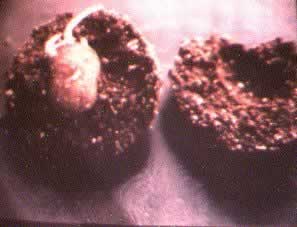 As the plant grows the roots remain in constant contact with elicitors in the
matrix thus providing a continuing source of stimulation for the plant's enzyme
system. The invading fungus pathogen is inhibited or repelled when it attempts
to infect the plant. Dr. Jim Linden, microbiologist, Colorado State University,
received a Colorado Institute for Research in Biotechnology (CIRB) grant to
study Aeroponics International's encapsulation technology as an elicitor delivery
system. Linden's greenhouse study found that the EcoSeed matrix had no phytotoxic
effect on tuber emergence and tuber set. Dr. Linden's laboratory is currently
conducting assays to evaluate the influence of encapsulated elicitors on plant
enzyme levels. Aeroponics International and Dr. Linden have applied for additional
research grants to conduct further greenhouse studies involving controlled pathogen
experiments on potatoes.
As the plant grows the roots remain in constant contact with elicitors in the
matrix thus providing a continuing source of stimulation for the plant's enzyme
system. The invading fungus pathogen is inhibited or repelled when it attempts
to infect the plant. Dr. Jim Linden, microbiologist, Colorado State University,
received a Colorado Institute for Research in Biotechnology (CIRB) grant to
study Aeroponics International's encapsulation technology as an elicitor delivery
system. Linden's greenhouse study found that the EcoSeed matrix had no phytotoxic
effect on tuber emergence and tuber set. Dr. Linden's laboratory is currently
conducting assays to evaluate the influence of encapsulated elicitors on plant
enzyme levels. Aeroponics International and Dr. Linden have applied for additional
research grants to conduct further greenhouse studies involving controlled pathogen
experiments on potatoes.
Research by Aeroponics International
During 1995 Aeroponics International tested the Ranger
Russet EcoSeed in the field to study the effect of encapsulation on Rhizoctonia
Stem Cankering. The plot was located at the Colorado State University Horticultural
Farm located near Ft. Collins. Data indicates a statistically significant reduction
in the percentage of stem area cankered for the encapsulated seedpiece treatments
versus non-encapsulated mini tubers. Important additional research and development
efforts are being directed at determining optimum concentration of elicitors
in the encapsulant material and studies to further improve the shelf life of
encapsulated mini tubers. The selected data included herein point to substantial
agreement between Aeroponics International's preliminary results and published
research mentioned earlier.
Third Party Field Verification
A field plot located in Southern Idaho was sponsored
by Aeroponics International in 1995. Mini tubers were encapsulated with elicitors
and compared against non-encapsulated mini tubers. Dr. Gary Beaver, Southern
Idaho Agricultural Researchers & Consultants, found a statistically significant
reduction of Rhizoctonia Stem Cankering. Dr. Gary D. Franc of University of
Wyoming collected data from a similar field study using encapsulated R. Norkotah
mini tubers versus nonencapsulated mini tubers in 1996. The data
collected by Dr. Franc further indicates statistically significant reduction
in Rhizoctonia Stem Cankering Dr. Cecil Stushnoff, Director of Biotechnology,
Colorado State University who is familiar with the company's efforts, said that
EcoSeed is revolutionary and has the potential to change the way plants are
grown. Dr. Monty Harrison, Professor Emeritus, CSU, a member of Aeroponics International's
science advisory board, has reviewed the data and concurs that EcoSeed technology
has great potential value for the potato industry.
Rapid Propagation BioTechnology
(RPB)
Aeroponics International also holds patent
rights for an Aeroponic method and apparatus developed
by Richard Stoner for greenhouse crop production. It utilizes an enclosed pulsed
application of a hydro-atomized nutrient mist for rapid propagation of plants
from cuttings. The technology was originally marketed by Genisis Technology,
of Boulder, CO. There are over 1,500 installations of the
Genisis Aeroponic technology worldwide. 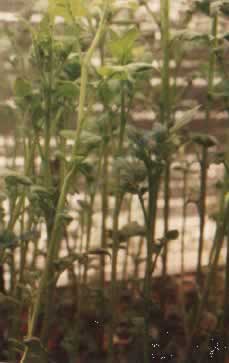 Stoner
left Genisis in 1986 and acquired the patent rights in 1988. The original Genisis
Aeroponic system has been significantly improved and redesigned for mini tuber
production by Stoner since 1989. The improvements virtually replace in vitro
and greenhouse Manitoba production. Micro propagation specialists and other
plant scientists who have observed this "new generation"
of Aeroponics, called RPB by Aeroponics International,
Stoner
left Genisis in 1986 and acquired the patent rights in 1988. The original Genisis
Aeroponic system has been significantly improved and redesigned for mini tuber
production by Stoner since 1989. The improvements virtually replace in vitro
and greenhouse Manitoba production. Micro propagation specialists and other
plant scientists who have observed this "new generation"
of Aeroponics, called RPB by Aeroponics International,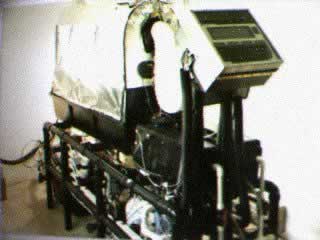 concur that it represents a novel and totally new approach to Manitoba production.
RPB is expected to be 600% to 1400% more productive per sq. ft. compared to
current greenhouse micro propagation. The company plans to patent RPB and sell
mini tubers to the potato industry. The company's strategic business plan anticipates
offering encapsulated RPB mini tubers as EcoSeeds at prices competitive with
traditional mini tubers.
concur that it represents a novel and totally new approach to Manitoba production.
RPB is expected to be 600% to 1400% more productive per sq. ft. compared to
current greenhouse micro propagation. The company plans to patent RPB and sell
mini tubers to the potato industry. The company's strategic business plan anticipates
offering encapsulated RPB mini tubers as EcoSeeds at prices competitive with
traditional mini tubers.
Future Plans
There are no products currently on the market that
are designed to stimulate molecular level defense mechanisms in plants to control
fungus pathogens. It is Aeroponics International's goal to offer this same disease
control strategy to other major crops such as sugar beets, barley, beans, and
other large seeded vegetables. There is a broad potential application for EcoSeed
technology in commercial agriculture and also among the millions of home gardeners.
Aeroponics International plans to explore the feasibility of licensing its technologies
to other seed production companies and other agribusiness firms.
[1] The presence of a thaumatin-like protein, a ase
and a glucanase among the pathogenesis related proteins of potato (Solanum tuberosum).
Physiol. and Mol. Plant Pathol. 36:325-338
[2] Induction of ases and b- 1,3-glucanases in Rhizoctonia
solani-infected rice plants: Isolation of an infection-related ase DNA clone.
Physiol. Plant 97: 39-46
Biocontrol info:
Biocontrol Brochure
BEYOND All Natural Plant Amendment™ Brochure
Testimony Letters
Purchase
ODC™ / Beyond directly from Aeroponics International
Field Research Data
ODC™ on-line Brochure
Purchase
ODC / Beyond Biocontrols and Aeroponic Units and Systems
Use natural biocontrol products visit www.biocontrols.com